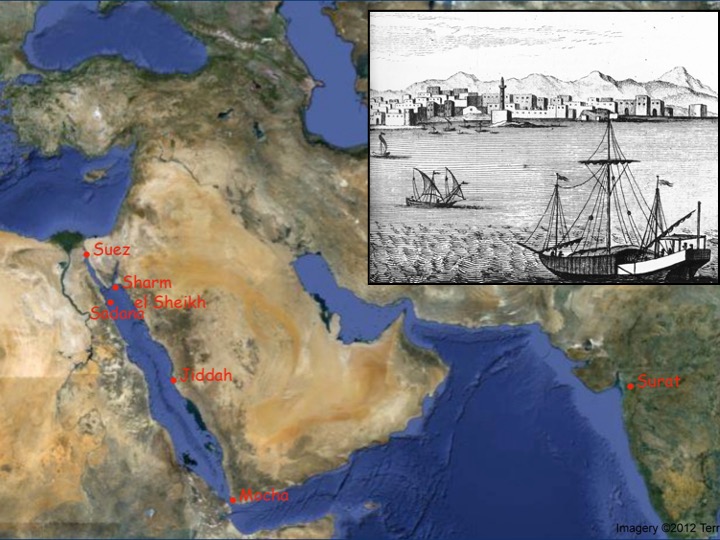
RED SEA
Sometime after 1764, an immense ship of more than 900 tons broke loose from its mooring and slammed into a fringing coral reef in the Red Sea, coming to rest at its base and splitting in two along the keel line. In cooperation with Egyptian authorities and institutions, INA’s Egyptian branch meticulously examined the 50-meter (164′) vessel and recovered a wealth of details that help to reconstruct its final voyage.
A local informant pointed Doug Haldane and Cheryl Ward to the sprawling site during a 1994 Red Sea survey. In addition to Chinese export porcelain, European wine and case bottles, and thin-walled water jugs for trade, the well-preserved ship timbers provided clues to complex trade relationships. This ship, Egypt’s first shipwreck excavation in the Red Sea, sank while headed north, probably to Suez, on a return journey from the markets of Jeddah in Saudi Arabia or perhaps as far south as Mocha in Yemen.
Over the next three seasons, our crew made nearly 5000 dives between 28–40 m deep, recovering porcelain, thousands of earthenware water jugs, spices from the Indian Ocean, stacks of black-lipped pearl oyster shells, fragrant incense, more than 100 coconuts and green unroasted coffee.
One of the most critical and engaging question any excavation hopes to answer is the original of the ship and its crew. The ship itself is not built in a familiar European, Indian, or eastern Mediterranean 18th-century pattern. As to the crew, Arabic inscriptions with Hijri dates on the rims of copper cooking and serving items yielded the names of the rais, or captain, and perhaps ship’s officers, and “Turkish style” clay pipe bowls link them to Egyptian and Red Sea localities.
Research by Michel Tuchsherer in the archives of Istanbul, accounts of European travelers, along with tax and customs documents, identify a strong ship-building industry at Suez in the 1760s, where three ships of the largest size (like the Sadana vessel) were built from pine and oak timber with iron fittings and anchors provided by the Ottoman government. The same woods were used to build the Sadana ship, which sank with at least six grapnel anchors of the ‘Turkish style’ on board.
The Egyptian government contracted these large ships to carry grains, lentils, oil and other goods to the port of Jeddah for the provisionment of Mecca. Sometimes the ships carried 500 or more passengers for the Haj, and in both instances, acquired valuable cargo at markets on the eastern Red Sea, especially Yemeni coffee, for the return trip, a trip the Sadana ship never completed.
Because archaeologists encountered only a limited number of personal finds from charcoal grills and copper stew pots to smoking paraphernalia, small glazed bowls, and large trays for shared meals, we know the ship, though it looked “empty” when first visited, was not carrying hundreds of passengers. Instead, the Sadana ship was laden with cargo, not passengers, on this return from a western Arabian port. Understanding how the different raw materials and finished products came to be at the base of a reef on Egypt’s eastern shoreline results from the clues painstakingly gathered by the international team.
Cheryl Ward, archaeological director of the excavation, is currently preparing a volume focused on the Sadana Island ship for the Ed Rachal Nautical Archaeology Series at Texas A&M University Press.
Relevant Bibliography
Haldane, C. [Ward]. 1996. “Sadana Island Shipwreck, Egypt: Preliminary Report.” International Journal of Nautical Archaeology 25: 83–94.
Tuchscherer, M. 1997. “A propos de l’assemblage de trois navires ottomans dans l’arsenal de Suez (1762-1767).” In Méditerranée, mer ouverte. Actes du Colloque de Marseille (21-23 septembre 1995) I, edited by C. Villain-Gandossi, L. Durteste, and S. Busuttil, 323–334. Malta.
Ward, C. 2000. “The Sadana Island Shipwreck: A Mid-Eighteenth Century Treasure Trove.” In A Historical Archaeology of the Ottoman Empire: Breaking New Ground, edited by U. Baram and L. Carroll, 185–202. New York: Kluwer/Plenum.
———. 2000. “The Sadana Island Shipwreck: The Red Sea in Global Trade.” Saudi Aramco World 51.6: 14-21.
———. 2001. “The Sadana Island shipwreck: an eighteenth-century AD merchantman off the Red Sea coast of Egypt.” World Archaeology 32.3: 371–385.
———. 2005. “Red Sea Treasure Ship.” In Beneath the Seven Seas, edited by G.F. Bass, 186–91. London: Thames & Hudson.
———. 2014. “The Sadana Island Shipwreck: From the Red Sea to Ottoman Istanbul.” In Seapower, technology and trade. Studies in Turkish Maritime History, edited by D. Couto, F. Gunergun, and M. Pedani, 153–62.
Ward, C., and U. Baram. 2006. “Global Markets, Local Practice: Ottoman-period Clay Pipes and Smoking Paraphernalia from the Red Sea Shipwreck at Sadana Island, Egypt.” International Journal of Historical Archaeology 10.2: 135–58.
M.A. Theses
Braun, Kathy. 2005. “A Cargo of Islamic Ceramics from the Eighteenth-Century Sadana Island Shipwreck in the Red Sea: Typology, Form and Function of Qulal and Other Shapes.” Florida State University.
Sharma, Mini. 2003. “Utilitarian Ceramic Ware from the Sadana Island Shipwreck, Egypt.” Florida State University.
Willis, Kathryn. 2001. “Copper Artifacts from the Sadana Island Shipwreck.” Texas A&M University.
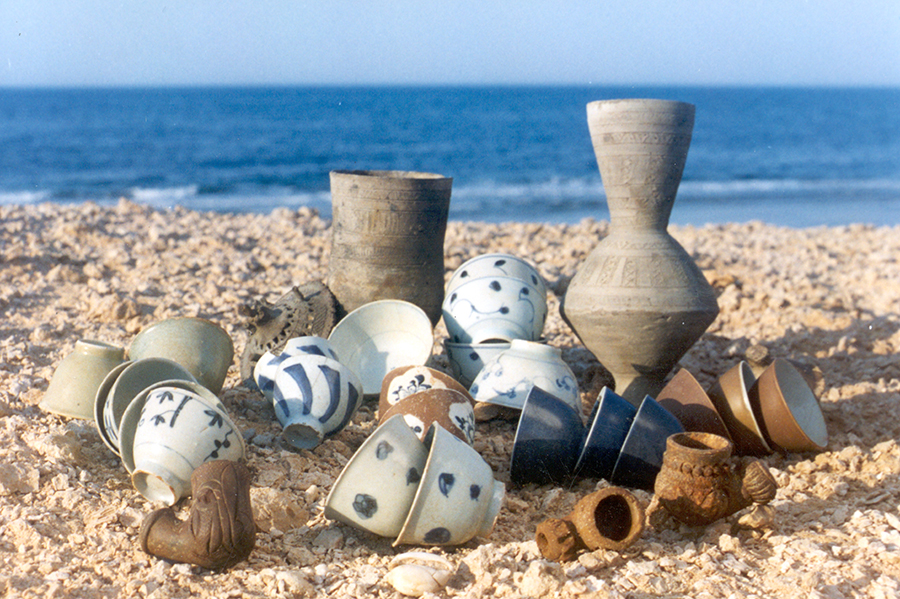
ABOVE: The Chinese export porcelain cargo included coffee cups with a celadon green glaze and so-called Batavia brown and blue-and-white decoration. The solid blue cups originally gleamed with delicate gold patterns, and brilliant scarlet and gold enamel on other cups—worn off in the sea—left ghosting traces recovered by long-time INA artist Netia Piercy.
Beakers with lids, and jugs with screens to keep flies out of their contents were shipped by the thousands in ships like this. Clay pipe bowls with a range of designs are one of the few categories of personal items from the site.
European accounts of similar sized ships suggest they carried 500-600 passengers from Suez to Jeddah for the pilgrimage to Mecca, with crews of 75 men and sometimes their wives and children. The ship was laden with cargo, not passengers, on this return from a western Arabian port. Archaeologists encountered only a limited number of personal finds from charcoal grills and copper stew pots to smoking paraphernalia, small glazed bowls, and large trays for shared meals, but many clues to the vessel’s final cargo.
PHOTO GALLERY
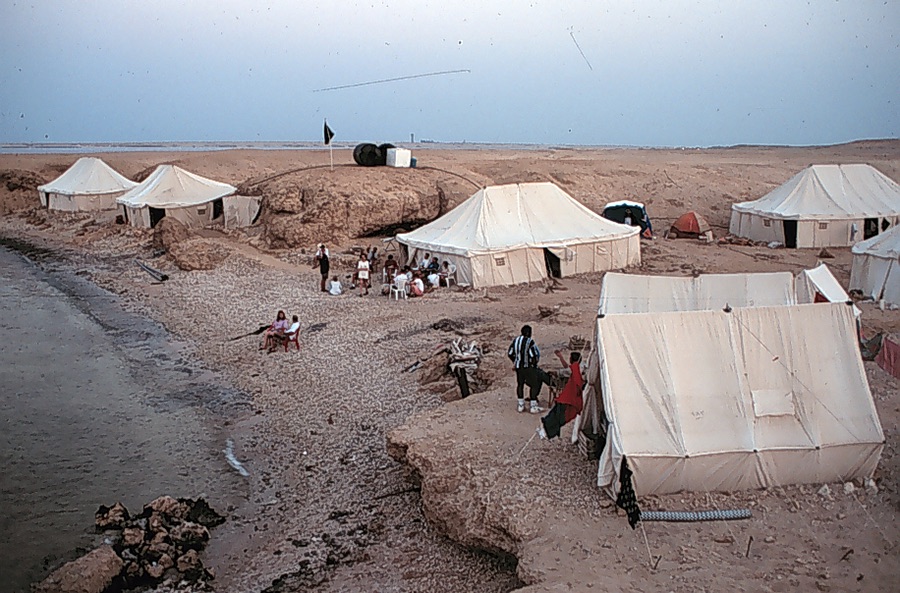
Twilight on the edge of the Red Sea, home to a crew of up to 40 in canvas wall tents under incredible night skies and sunny days.
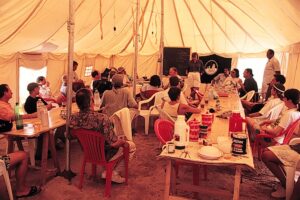
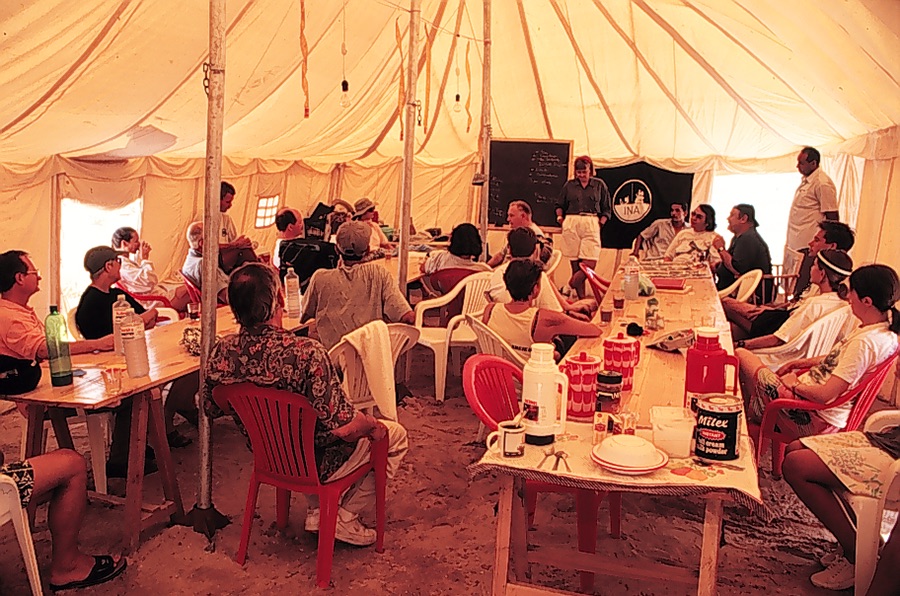
Dive meetings after meals in the mess tent.
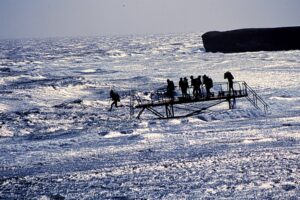
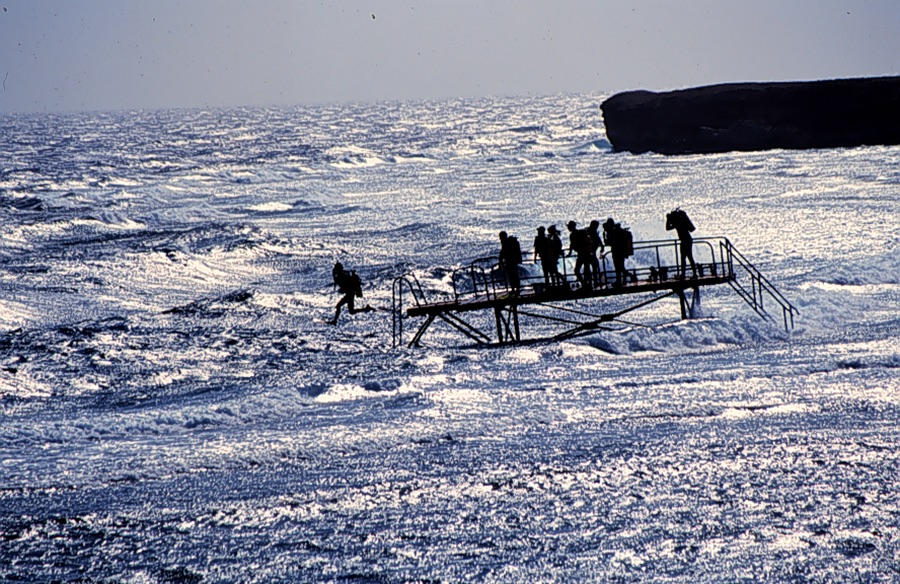
INA-Egypt founder Douglas Haldane designed this platform to allow diving safety standards to be followed and provide for ease of recovery of artifacts.
Twilight on the edge of the Red Sea, home to a crew of up to 40 in canvas wall tents under incredible night skies and sunny days.
Dive meetings after meals in the mess tent.
INA-Egypt founder Douglas Haldane designed this platform to allow diving safety standards to be followed and provide for ease of recovery of artifacts. The reef’s edge is pounded by waves and razor sharp. Jumping off the end of the platform, each pair of excavators waited to get a thumbs up from the dive officer and then turned and swam about 20 ft to descend about 100 ft to the base of the reef.
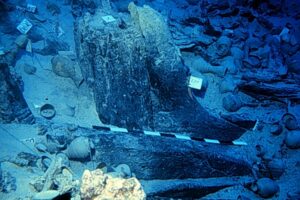
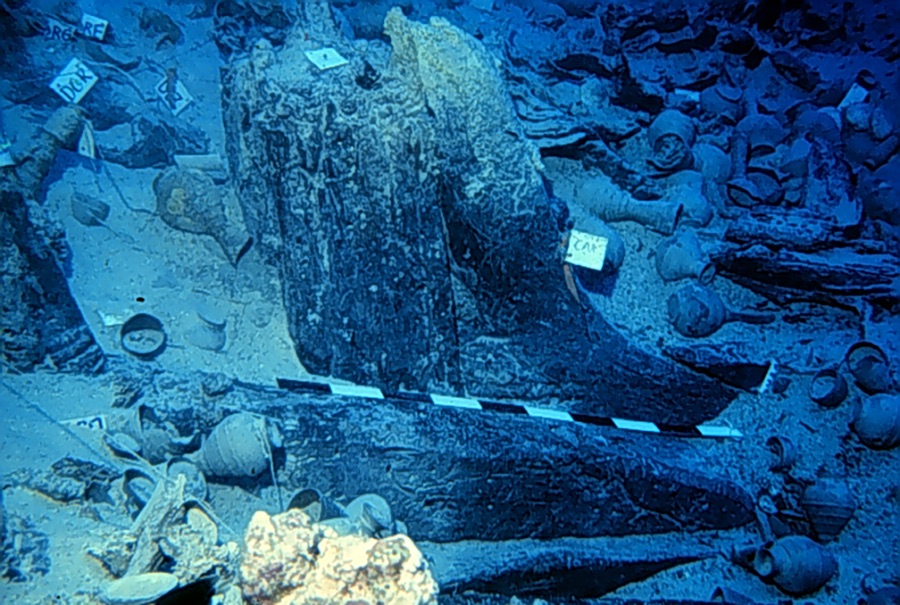
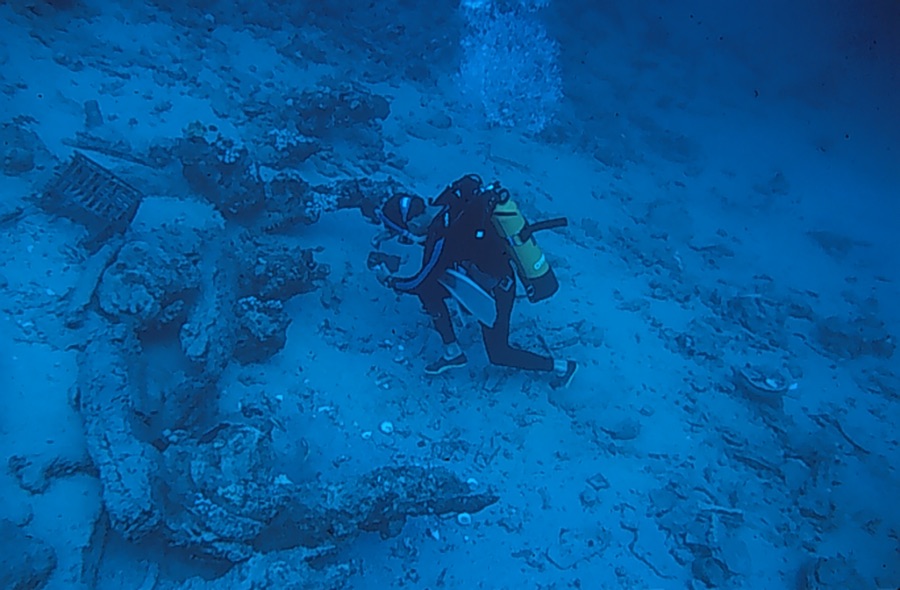
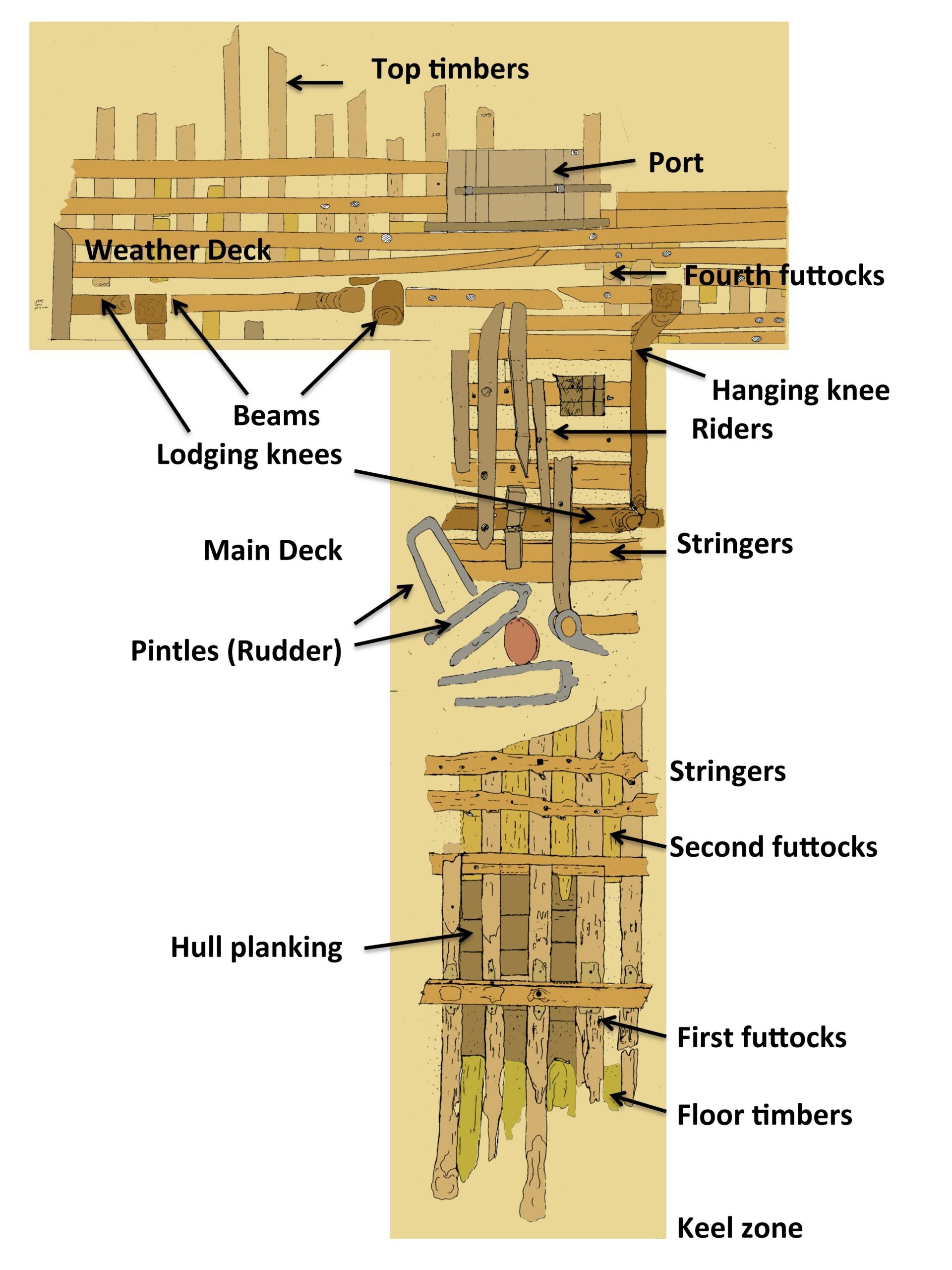
Massive knees and beams in the stern are surrounded by some of the thousands of earthenware water jugs (qulal in colloquial Egyptian) in a wide range of shapes and decoration.

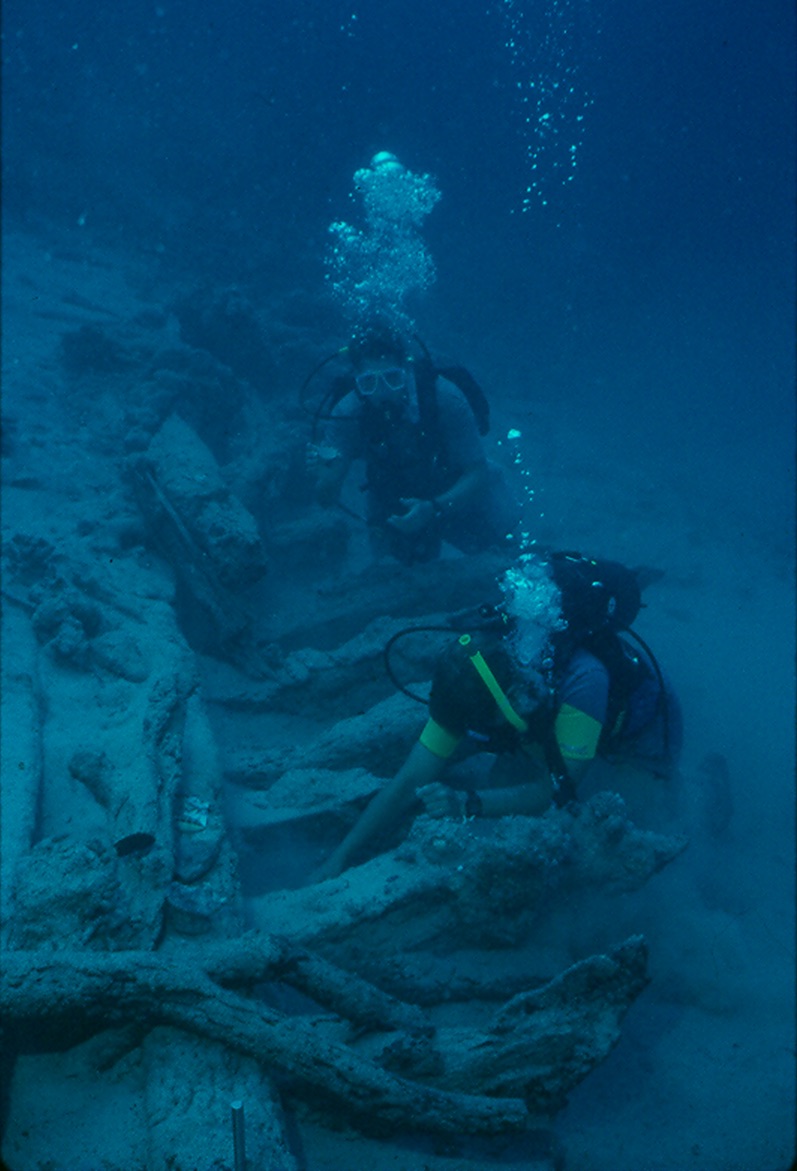
Futtocks and stringers above the weather deck at midships are typical of the size and condition of the ship’s starboard side today.
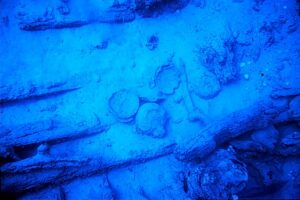
Although unsanctioned visitors to the site removed over 10,000 pieces of porcelain in the early 1990s, INA’s limited excavations of 1995–1998 resulted in the recovery of substantive representative assemblages of cargo and life aboard.
Massive knees and beams in the stern are surrounded by some of the thousands of earthenware water jugs (qulal in colloquial Egyptian) in a wide range of shapes and decoration. More than 3,000 were present on site. INA excavated and conserved about 900 examples of more than 20 basic designs, now in storage at the Alexandria (Egypt) Museum.
The futtocks and stringers above the weather deck at midships are typical of the size and condition of the ship’s starboard side today. Built with four decks and likely a stern castle, the ship’s overall dimensions are approximately 50 m long, 10 m deep at midships, and about 18 m wide.
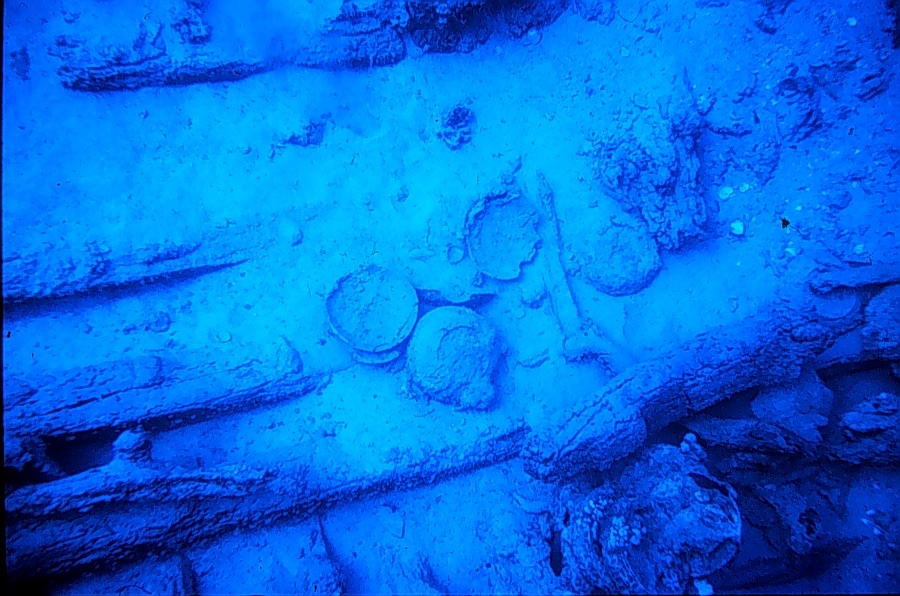
Originally shipped in stacks low in the midships hold, these large blue-and-white porcelain dishes (34-38 cm diameter) tumbled downslope to the stringers above the weather deck. The notch in the timber below the concreted stacks identifies a displaced rider frame above the remains of a beam supported by lodging and rising knees. Bright white porcelain sherds with fresh breaks attest to damage from other site visitors.
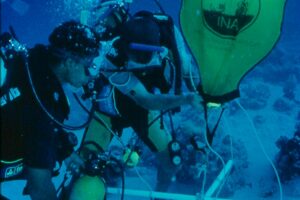
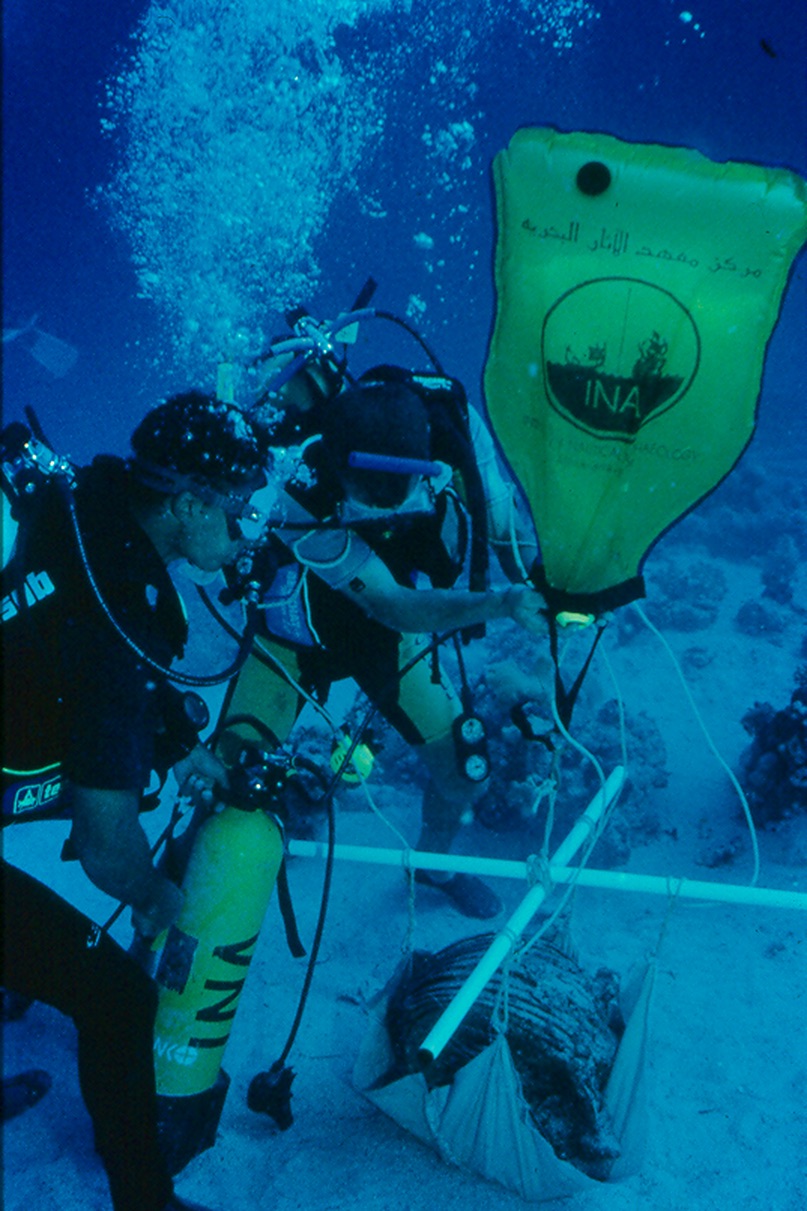
Moving a stack of porcelain dishes from the base of the reef using air balloons and simple slings.
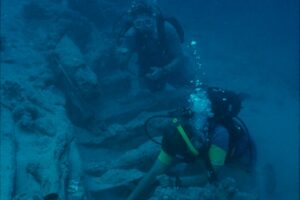
NAP graduate Peter Hitchcock recording wood and excavating in the ship’s top timbers. Built of oak and pipe from the Mediterranean, the ship’s construction is a local Red Sea type.
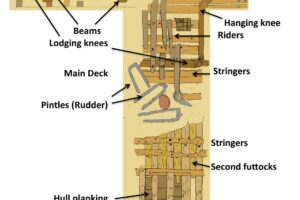
Representation of the ship's structure (Courtesy of C. Ward)
Moving a stack of porcelain dishes that weighs about 80 pounds from the base of the reef to navigate across the shallow zone a hundred feet above them, these team members used air balloons and simple slings. A team of five or six non-divers waits for them in the shallow zone on days with quiet waves to carefully guide the artifacts to holding pools on the beach.
NAP graduate Peter Hitchcock assisted in recording wood and excavating in the ship’s top timbers near a port last closed almost 250 years ago. Built of oak and pine from the Mediterranean, the Sadana ship’s construction has similarities to other 18th-century Red Sea vessels from Sharm el Sheikh to Umlaj.
Representation of the ship’s structure (courtesy of C. Ward).